

Latest Products


Contact Us
Hebei Nanfeng Automobile Equipment (Group) Co.,Ltd
Phone: +86 18811334770
Tel: +86 0317 8620396
Tel: +86 010 58673556
Candy Jiao
E-mail: nh.jiao@auto-parkingheater.com
Email: nh.li@auto-parkingheater.com
Add: Room 505, Building B, Free Town Center, No.58, East Third Ring South Road, Chaoyang District, Beijing, 100022, P.R.China


Electric Vehicle Liquid Cooling Pump
Primarily used in battery-electric and hybrid vehicles, it operates in conjunction with PTC coolant heaters, battery thermal management systems (BTMS), and cooling circuits for electric motors and power electronics; it serves as a core fluid actuator within the thermal management system and differs from the belt-driven mechanical water pumps found in internal combustion engines.
Description
If you're looking for the electric vehicle liquid cooling pump, welcome to wholesale the product from our factory. As one of the leading manufacturers and suppliers in China, we will offer you the best service and fast delivery. Now, check the quotation with our seller.
Electric Vehicle Liquid Cooling Pump
Products Description


Product Description
Electronic water pumps adjust the flow rate of circulating coolant based on vehicle operating conditions, enabling precise temperature control for components such as electric motors, electronic control units, air conditioning systems, and batteries. They are critical components in new energy vehicles and liquid-cooled energy storage systems.
Products parameters

| Item | Parameter |
|---|---|
| Model | 02.03.862.5107 |
| Rated Voltage | DC 24V |
| Operating Voltage Range | DC 18‑32V |
| Rated Power | 650W |
| Rated Operating Conditions | At a head of 20m, ★Flow Rate ≥ 5400 L/h, ★Current ≤ 29A |
| Max Head | ≤27M |
| Motor Type | BLDC Brushless DC Motor |
| Control Mode | ON-OFF / PWM / CAN bus(optional) |
| Protection Class | IP68 |
| Coolant Media | Water‑glycol antifreeze coolant |
| Ambient Temperature | ‑40℃ ~ +85℃ |
| Storage Temperature | ‑40℃ ~ +125℃ |
| Expected Service Life | ≥20000 hours |
| Warranty | 12 months |
Q-H Flow-Head Performance Curve
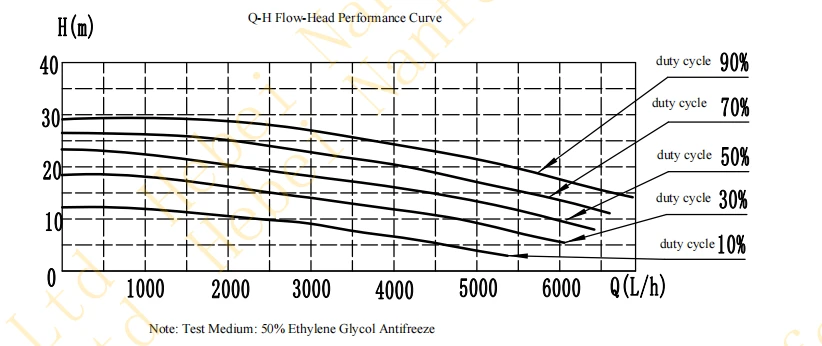
Note: Test Medium: 50% Ethylene Glycol Antifreeze
Workflow
The vehicle thermal management controller (TCU/VCU/PTC controller) issues a speed command → the water pump's internal driver board receives the command → the three-phase brushless motor is driven to rotate → the centrifugal impeller spins, creating negative pressure within the pump chamber to draw coolant in through the inlet (IN), pressurize it, and discharge it through the outlet (OUT), thereby driving flow through the circuit to facilitate heat transfer (battery preheating, PTC heating circulation, and motor cooling).
Characteristics of centrifugal pumps

Characteristics of centrifugal pumps
Higher rotational speeds result in greater flow rates and discharge heads; flow rate is influenced by pipeline resistance.
Dry running is prohibited: Idling without cooling fluid causes rapid bearing burnout; regarding the PTC circuit, the pump must start and establish flow before the PTC heater is activated to prevent triggering the dry-run protection.
Product Features


Product Features
Low energy consumption and high efficiency.
Extended service life, with a continuous operating time exceeding 20,000 hours.
Flexible control methods (PWM, CAN) providing on-demand cooling capacity.
Multiple operational protections (over-temperature, over-voltage, over-current, etc.).
Control Methods

Control Methods (Three Mainstream Types)
1. PWM Control (Most common; widely used with PTC-integrated water pumps)
Interface: 3-pin (12V power, GND, PWM signal)
Common PWM frequency: 100Hz–1kHz; duty cycle corresponds to target speed;
Example: 10% duty cycle for low speed, 90% for near-maximum speed;
Drawback: Can only receive commands; cannot report speed or fault status (though some pumps provide an FG speed feedback pin for pulse output).
2. LIN Bus Control
Single-wire LIN communication; unlike PWM, the pump can transmit actual speed, voltage, and fault status back to the controller.
Suitable for thermal management systems with multiple pumps; simplifies the wiring harness.
3. CAN Bus (High-end thermal management, commercial vehicles)
Acts as a CAN network node; receives vehicle CAN command messages and reports speed, current, and fault DTCs; can share the same CAN network as the PTC heater, facilitating bench diagnostics and debugging.
When debugging a PTC system on the test bench: Prioritize verifying the water pump control mode; many beginners make the mistake of simply applying power, resulting in the pump failing to spin due to the absence of PWM/LIN/CAN commands.
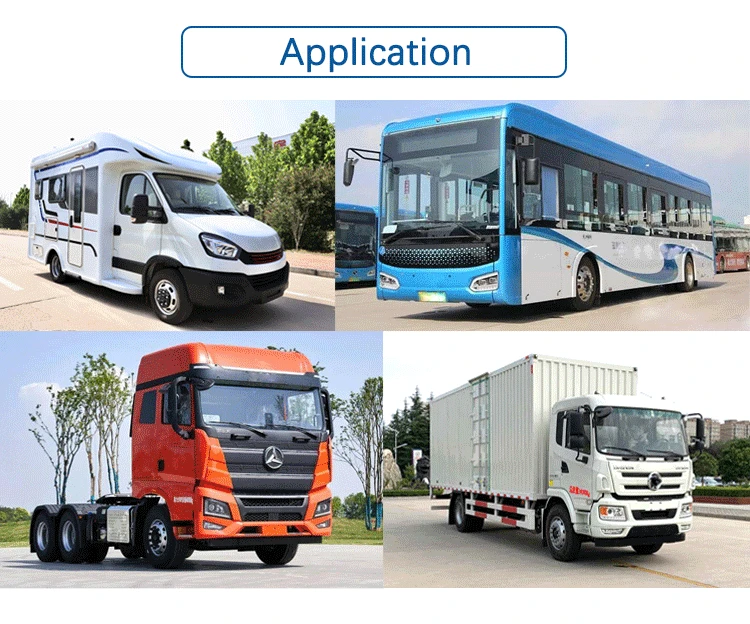
Products application
PTC Coolant Heater Circuit (Cabin Heating Circuit)
Circulates coolant through the liquid-cooled PTC to deliver heat to the vehicle's heater core; the water pump must be started first to establish flow before activating the PTC's high-voltage heating function to prevent the PTC from triggering dry-heating protection.
Traction Battery Thermal Management System (BTMS) Circuit
Low temperature: Battery preheating (PTC heating; water pump circulates coolant to the battery cold plate); High temperature: Heat dissipation via the radiator.
Drive Motor & Motor Controller Cooling Circuit
Cooling circulation loop for the drive motor, OBC, and DC-DC converter.
Heat Pump System Auxiliary Circulation Pump
Hybrid models: Independently cools the turbocharger and EGR system after the engine shuts down.

Hot Tags: electric vehicle liquid cooling pump, China, factory, suppliers, manufacturers, seller, wholesale, quotation
You Might Also Like


