Latest Products



Contact Us
Hebei Nanfeng Automobile Equipment (Group) Co.,Ltd
Phone: +86 18811334770
Tel: +86 0317 8620396
Tel: +86 010 58673556
Candy Jiao
E-mail: nh.jiao@auto-parkingheater.com
Email: nh.li@auto-parkingheater.com
Add: Room 505, Building B, Free Town Center, No.58, East Third Ring South Road, Chaoyang District, Beijing, 100022, P.R.China


7kw PTC Coolant Heater
The future of mobility is electric. Renewable energy sources allow for carbon-reduced mobility. Anew generation of vehicles is emerging--E-cars and hybrid.
Increased electric vehicle rang results in less engine heat and thus to higher heating requirements.
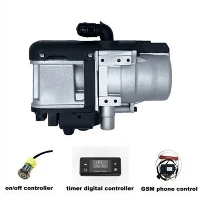
The 7kw high voltage coolant heater is mainly used for heating the passenger compartment ,defrosting and removing fog on the window,or preheating battery thermal management system battery ,to meet the corresponding regulations, functional requirements.
Description
Products Description

PTC technology replaces traditional resistance wire with solid-state ceramic chips. The specially designed ceramic materials are a tremendous improvement over coiled wire heaters. A PTC heating element is a ceramic resistor; as the temperature increases, its resistance increases. These are small, high-watt-density, energy-efficient heaters. These unique heating devices are used in various applications where quick, even heating is required, such as traffic control systems, medical equipment, communications, farm, industrial equipment, aerospace, transportation, and even the latest electric automobiles.
Products Operating Principle

At ambient temperature, the PTC ceramic element has low resistance and heats up rapidly upon energization. When the temperature reaches the Curie point, the PTC resistance rises sharply, automatically limiting the heating power to achieve self-regulation and preventing continuous overheating. Heat is transferred via the metal substrate to the coolant in the internal flow channels, which is then circulated throughout the vehicle's thermal management loop by an electric water pump. The unit features an integrated controller that supports CAN bus communication with the vehicle's VCU/BMS, allowing for dynamic adjustment of output power.
Products Details Parameters
| Item | W09-1 | W09-2 |
| Heating output | 5kw, 6kw, 7kw, 8kw @10L/min,T_in=60℃ | |
| Rated voltage(VDC) | 350V | 600V |
| Working voltage(VDC) |
250-450 |
450-750 |
| Impulse current(A) | ≤40@450V | ≤25@750V |
| Controller low voltage(VDC) | 9-16 or 16-32 | 9-16 or 16-32 |
| Control signal |
CAN2.0B,LIN2.1 |
CAN2.0B,LIN2.1 |
| Control model | Gear (5th gear) or PWM | Gear (5th gear) or PWM |
| Heater dimension | 258.6*200*56mm | |
| Heater weight | <2.7kg | |
| High voltage connector in heater | Amphenol HVC2P28MV104 | |
| High voltage connector in car | Amphenol HVC2P28FS104 | |
| Low voltage connectors | 320Q60A1-LVC-4 (Haichen A02-ECC), & Sumitomo 6189-1083 | |


Products Advantages

Advantages over other heat sources
Compared to waste heat from internal combustion engines: It does not rely on engine operation, ensuring a stable heating source even when the engine of a hybrid vehicle is shut off; for pure electric vehicles (which lack an engine), PTC serves as a traditional heating solution.
Compared to heat pumps: Heat pump heating performance degrades significantly in extremely low temperatures, whereas PTC is unaffected by low ambient temperatures and provides stable heating, often serving as a low-temperature auxiliary heat source for heat pumps.
Compared to standard resistance wire heaters: Resistance wires are prone to burnout and overheating (posing a fire risk), while PTC features self-limiting temperature capabilities, offering greater safety redundancy.
Products Application

HVH Application electric Car

HVH Application electric Truck

HVH Application electric transportation

HVH Application electric Bus
Battery Electric Commercial Vehicles (Primary Use Cases)
Electric buses, electric heavy-duty trucks, sanitation vehicles, port terminal tractors, and electric dump trucks. Applications include cabin heating and windshield defrosting/demisting in winter, as well as preheating and thermal management of traction batteries in low-temperature environments. The high-power 7kW output is designed to accommodate spacious cabins and large-capacity battery packs.
Plug-in Hybrid (PHEV) Commercial Vehicles / Large PHEVs
When the engine is shut off and no waste heat is available, PTC heaters are used to provide cabin heating and battery preheating. While small-to-medium passenger vehicles typically utilize 3–5kW units, the 7kW specification is reserved for large hybrid commercial vehicles.


The PTC high-voltage hydronic heater utilizes PTC ceramic heating elements and integrates high-voltage drive circuitry with CAN communication control, offering features such as self-limiting temperature, rapid heating, and high safety and reliability. It generates heat for new energy vehicles via coolant heat exchange and is primarily used for low-temperature preheating of traction batteries, cabin heating, and windshield defrosting in electric commercial vehicles, fuel cell vehicles, and specialty electric vehicles. The unit contains no rotating parts, offers excellent vibration resistance, supports multi-level power adjustment, and is compatible with 350V/800V vehicle high-voltage architectures.
Products Certifications

Products FAQ
After installation and power-up, the heater fails to operate; what are the first three points to check?
① Check if the 12V low-voltage power supply is normal and if the connectors are securely locked;
② Check if the VCU/BMS has issued enable and power request signals;
③ Check if the vehicle's high-voltage circuit is closed and if there is coolant flow. The heater operates only upon receiving a command; it does not automatically begin heating upon startup.
Under what conditions will the heater automatically reduce power or shut down completely?
① Excessive inlet coolant temperature;
② Heater unit overheating;
③ Insufficient coolant flow;
④ High-voltage level outside the operating range;
⑤ Insulation fault;
⑥ Loss of CAN communication; BMS thermal management restriction commands. These are standard protection logic responses and do not necessarily indicate component damage.
What are the requirements for the coolant? Can different types of antifreeze be mixed?
You must use the ethylene glycol coolant specified for the vehicle; mixing antifreeze products with different formulas or brands is prohibited. Mixing can cause sediment formation, clogging heater channels, reducing flow, and triggering overheat protection; it can also corrode internal aluminum waterways, leading to slow leaks.
Does the heater housing require a ground connection? What are the consequences of a poor ground connection?
The housing must be reliably connected to the vehicle chassis ground. Poor grounding can lead to false insulation fault alarms during high-voltage insulation monitoring; furthermore, if internal insulation degrades, the protection circuit may fail to trigger, creating a safety hazard.
Can an 800V platform PTC coolant heater be installed directly onto a 400V vehicle?
They are not directly interchangeable. The voltage withstand ratings of the PTC ceramic chips differ. If an 800V heater is used in a 400V system, heating power drops significantly, resulting in poor heating performance; conversely, installing a 400V heater in an 800V vehicle will cause immediate PTC breakdown, component burnout, and insulation failure. Always verify the part number against the platform voltage.
Related Products


Hot Tags: 7kw ptc coolant heater, China, factory, suppliers, manufacturers, seller, wholesale, quotation, 10kw high voltage coolant heater, 12v hev ptc heater, PTC heater, 7kw beattery heater for ev, 600v PTC electric liquid heater, automotive PTC heater
You Might Also Like