
Comparison of Heating Systems between Traditional Fuel Vehicles and New Energy Vehicles
Fuel Vehicle Heating System
The thermal efficiency of a car's engine is relatively low. Only about 30%-40% of the energy generated by combustion is converted into the mechanical energy of the car. The rest is taken away by the coolant and exhaust gas. The heat energy taken away by the coolant accounts for about 25-30% of the combustion heat.
The heating system of a traditional fuel vehicle is to guide the coolant in the engine cooling system to the air/water heat exchanger in the cab. When the wind flows through the radiator, the high-temperature water can easily transfer heat to the air, thus blowing The wind that enters the cab is warm air.
Engine Cooling System Principle
When the hot engine coolant from the water intake pipe and return pipe of the heating system enters the heating core of the cockpit, the air in the cockpit begins to circulate over and over again under the action of the blower, and the air is blown through the heating core. Heating so it's easy to warm up in our cockpit.
After the coolant transfers heat to the air flowing through the heater core, the coolant temperature drops and flows back to the engine cooling system. This back and forth turns the engine's preheating into warm air in the cockpit. Traditional fuel vehicles basically use this principle, with low cost, good effect, and very energy saving.


New Energy Heating System
There are two main types of new energy heating systems, one is PTC heating, the other is heat pump technology, and PTC heating is divided into air PTC and antifreeze PTC.
PTC Heater
The heating principle of the PTC thermistor type heating system is relatively simple and easy to understand. It is similar to the resistance wire heating system, which relies on the current to generate heat through the resistance. The only difference is the material of the resistance. The resistance wire is an ordinary high-resistance metal wire, and the PTC used in pure electric vehicles is a semiconductor thermistor. PTC is the abbreviation of Positive Temperature Coefficient. The resistance value will also increase. This characteristic determines that under the condition of constant voltage, the PTC heater heats up quickly when the temperature is low, and when the temperature rises, the resistance value becomes larger, the current becomes smaller, and the PTC consumes less energy. Keeping the temperature relatively constant will also save electricity compared to pure resistance wire heating.
PTC heating is divided into water heating and air heating.
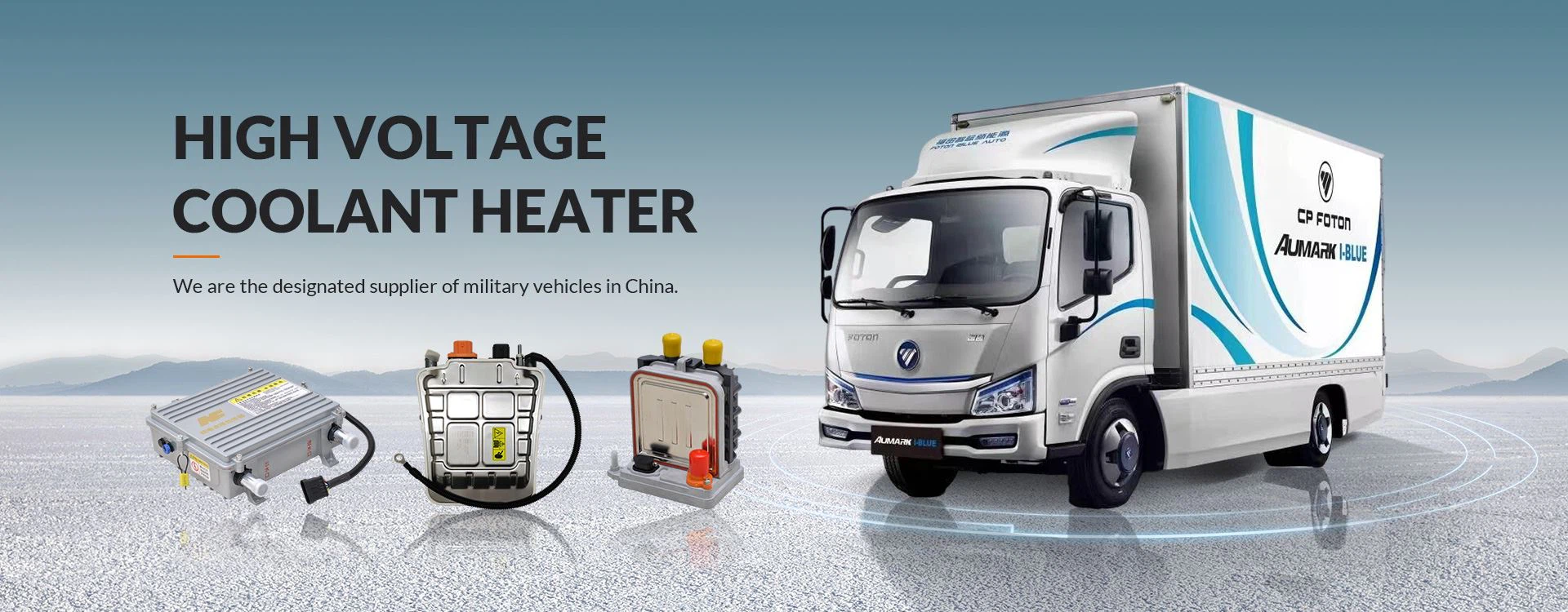
PTC water heating is often combined with the cooling water circuit of the motor. When the electric vehicle runs with the motor running, the motor will also heat up. In this way, the heating system can use part of the motor to preheat during the driving process, and it can also save some electricity. . The picture below is a water PTC.
After the water heating PTC heats the coolant, the coolant will flow through the heater core in the cab, and then it will be similar to the heater system of a fuel vehicle. Under the action of the blower, the air in the cab will be circulated and heated.


The air-heated PTC directly installs the PTC at the heater core of the cab, circulates the air in the car through the blower and directly heats the air in the cab through the PTC heater. The structure is relatively simple, but it is more expensive than the water-heated PTC. Charge electricity.


Heat Pump Heating System
The function of a heat pump is to transfer heat energy from a low-temperature heat source to a high-temperature heat source. Its working principle is similar to that of an air-conditioning refrigeration system, except that the direction of heat transfer is just the opposite. When the air conditioner is cooling, it transfers the heat from the room to the outside, while the heat pump heating system transfers the heat from the outside of the car to the inside of the car, just like installing the air conditioner in the cab and the air conditioner in the driver outdoor. The heat pump heating system is generally integrated with the air conditioning and refrigeration system, and the heat transfer path is controlled through the valve. In addition, when heating, the preheating of the power battery cooling system can be effectively used. In this respect, it is similar to the heating system of a conventional car.
Compared with the PTC heater, the heat pump system has higher thermal efficiency, lower energy consumption, and relatively less impact on the cruising range. But the disadvantages are also obvious: complex structure, high cost, slow heating speed, especially under low temperature conditions, the heating effect is poor.


