Current status of thermal management technology for electric vehicle battery system
Power battery heat dissipation research can be divided into air heat dissipation, liquid cooling heat dissipation, solid phase change material heat dissipation, and heat pipe heat dissipation. The existing main heat dissipation technologies are mainly the former three.
Air Cooling System
The air-cooled heat dissipation system is also called the air-cooled heat dissipation system. The air-cooled heat dissipation method is the simplest. It only needs to let the air flow through the surface of the battery to take away the heat generated by the power battery to achieve the purpose of cooling the power battery pack. According to different ventilation measures, the air-cooled type has two ways of natural convection heat dissipation and forced ventilation heat dissipation.
Natural convection heat dissipation does not rely on external forced ventilation measures (such as adding fans, etc.), but only uses the airflow generated by the fluid inside the battery pack due to temperature changes to cool and dissipate heat.
The forced convection cooling cooling system is a cooling system based on the natural convection cooling system plus the corresponding forced ventilation technology.
At present, there are mainly two types of air-cooled heat dissipation systems for power batteries: series and parallel. However, the effect of this method is poor, and it is difficult to achieve high temperature uniformity of the battery.
Liquid Cooling System
The liquid-cooled heat dissipation system of the power battery refers to a heat dissipation system in which the refrigerant directly or indirectly contacts the power battery, and then takes away the heat generated in the battery pack through the circulation of liquid fluid to achieve heat dissipation. The refrigerant can be water, a mixture of water and ethylene glycol, mineral oil, R134a, etc. These refrigerants have high thermal conductivity and can achieve better heat dissipation.
The current liquid cooling technology of power batteries also has a fairly mature technology, and it has been widely used in the heat dissipation system of electric vehicles. For example, the Tesla battery pack uses a liquid cooling method of a mixture of water and ethylene glycol to dissipate heat. The BMW i3 uses R134a for heat dissipation.
Liquid-cooled systems often require more complex and rigorous structural designs to prevent the leakage of liquid refrigerant and ensure the uniformity of battery cells in the battery pack, and the complex structure of the liquid-cooled system also makes the entire heat dissipation system become It is very bulky, which not only increases the weight of the whole vehicle, but also greatly increases the burden on the whole vehicle, and at the same time, due to the complexity of its structure and high sealing performance, it is relatively difficult to maintain and maintain the liquid cooling system, and the maintenance cost also increases accordingly.

Phase change material cooling system
The phase change material heat dissipation system uses the phase change material as the heat transfer medium, and uses the characteristics of the phase change material to store and release energy when the phase change occurs to achieve the effect of low-temperature heating and high-temperature heat dissipation for the power battery. However, the thermal conductivity of phase change materials is relatively low. In order to change the inherent defects of materials, people fill some metal materials into phase change materials. For example, in some studies, very thin aluminum plates are filled into phase change materials to improve thermal conductivity. the goal of. In order to improve the thermal conductivity of phase change materials, it has also been proposed to fill carbon fibers, carbon nanotubes, etc. into phase change materials.

Heat pipe cooling system
As an efficient heat conduction element, a heat pipe can quickly and efficiently transfer heat energy from one place to another, that is, it can quickly and effectively transfer heat between two objects.
In the thermal management system of electric vehicles, many scholars at home and abroad have also applied the heat pipe, a heat conduction element, to the heat dissipation of power batteries. Compared with the traditional forced convection heat dissipation system, in the heat dissipation system that introduces heat pipes, the power battery can not only maintain the temperature range of normal operation, but also maintain the uniformity of temperature among the battery cells, which is forced cooling. The effect that the cooling system cannot achieve. However, its mass and volume are too large, and there is a heat transfer limit.

Electric vehicle battery heating system
The four methods for dissipating heat from the battery are introduced above, and then the heating method to adapt the battery to the low temperature environment will be introduced.
The heating system is mainly composed of heating elements and circuits, among which the heating element is the most important part. Common heating elements include variable resistance heating elements and constant resistance heating elements. The former is usually called PTC (positive temperature coefficient), and the latter is a heating film usually composed of metal heating wires, such as silicone heating film, flexible electric heating film etc.
PTC is widely used because of its safe use, high heat conversion efficiency, rapid temperature rise, no open flame, and automatic constant temperature. Its low cost is a favorable factor for the current high-priced power battery. Insulated flexible electric heating film is another kind of heater, which can be bent according to the arbitrary shape of the workpiece, ensuring close contact with the workpiece and ensuring maximum heat energy transfer. Silicone heating film is a thin surface heating element with flexibility, but it needs to be in full and close contact with the heated object, and its safety is worse than PTC.

PTC Air Heater

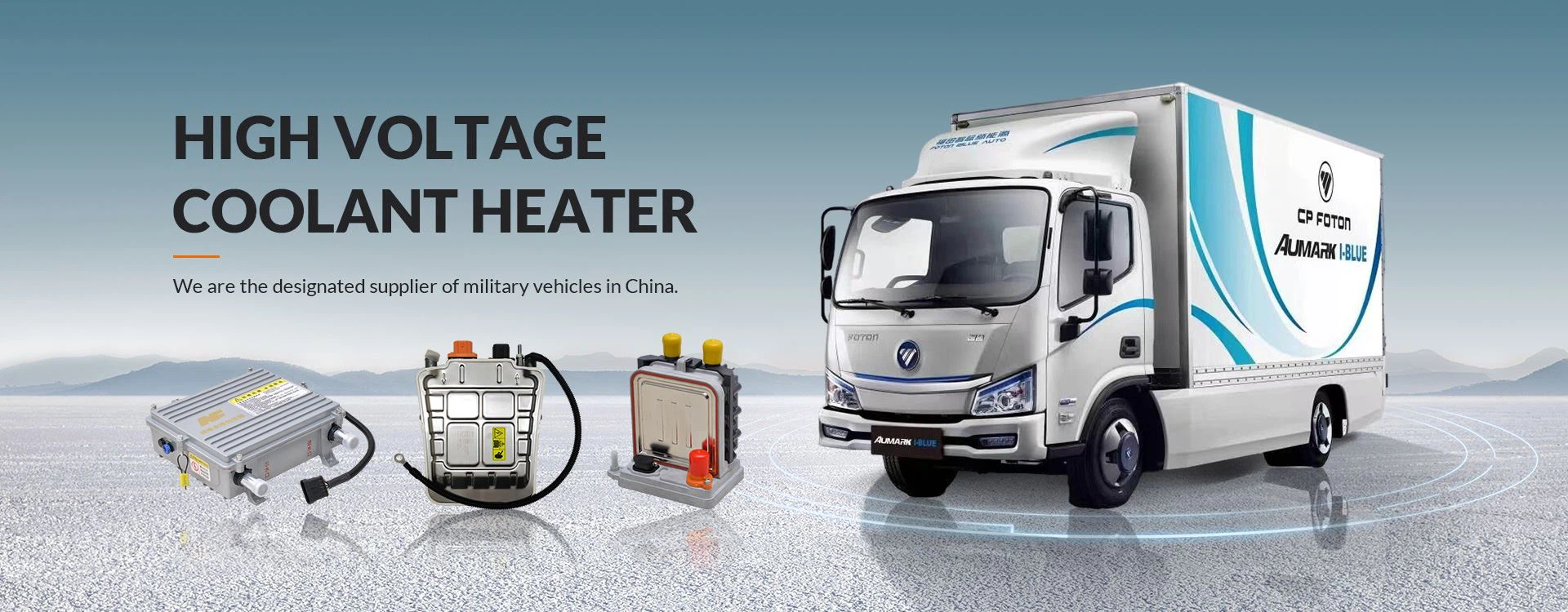
PTC Coolant Heater