
Comparison of Sliding Vane Compressors with Oil-Free Piston and Scroll Compressors
Vane-type compressor: A rotor is mounted eccentrically within a cylinder and features radial slots; vanes within these slots are pressed against the cylinder wall by centrifugal force, dividing the working chamber into multiple discrete volumes. As the rotor spins, the compressor sequentially performs intake, compression, and discharge. It features a simple structure with few parts, smooth operation with low vibration and noise, and a long service life with easy maintenance. Drawbacks include the need for effective lubrication between the vanes and the cylinder wall (though dry, self-lubricating models exist); wear and leakage limit efficiency; discharge pressure is generally moderate; and overall efficiency is average. They are commonly used in small-scale refrigeration, air conditioning, and vacuum pump applications.
Oil-free piston compressor: A crank-connecting rod mechanism drives a piston to reciprocate within a cylinder, compressing gas through volume changes. Oil-free models utilize self-lubricating materials (such as PTFE) for piston rings and guide rings, eliminating the need for lubricating oil in the cylinder; this ensures clean discharge free from oil contamination, making them suitable for sectors requiring high air purity, such as medical, laboratory, food processing, and electronics industries. They also offer a wide pressure range and can achieve high discharge pressures. Drawbacks include significant vibration and noise caused by reciprocating inertial forces, pulsating discharge, a relatively high number of wear-prone components (such as valve plates and piston rings), and significant temperature rise, necessitating cooling measures.

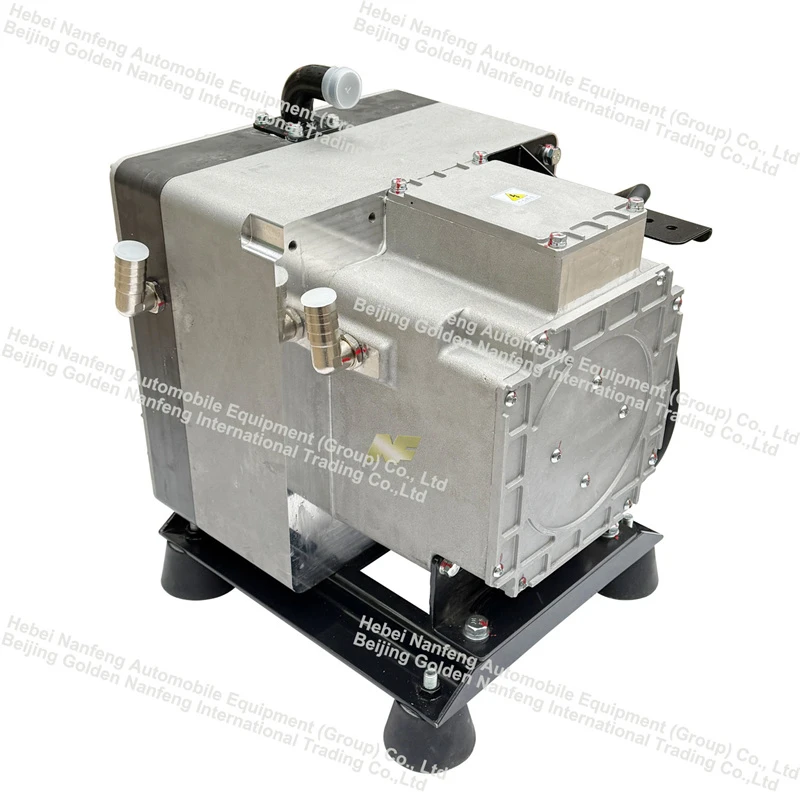
Scroll compressor: Two intermeshing scroll members-one orbiting and one stationary-form crescent-shaped compression chambers. The orbiting scroll moves in a small-radius circular orbit around the center of the stationary scroll, continuously compressing gas as it moves from the outer periphery toward the center for discharge. It operates without intake or discharge valves, minimizes leakage, and offers high volumetric and isentropic efficiency, low noise and vibration, a compact structure, fewer parts, and high reliability. However, the machining precision required for the scroll profiles is extremely high, manufacturing costs are elevated, and the unit is sensitive to liquid slugging and impurities. It is widely used in air conditioning, heat pump, and refrigeration systems.
| Comparison dimensions | Vane-type compressor | Electric Oil-Free Piston Compressor | Scroll Air Compressors |
| Overall efficiency | Middle | Middle | High |
| Noise and Vibration | Low | High | Low |
| Achievable discharge pressure | Low-to-medium | High | High-to-medium |
| Oil-free purity of the air source | Poor / Lubrication Required | excellent | You·Can Oil-Free |
| Manufacturing costs | Low | Low | High |


