

Advantages and Disadvantages of Scroll Air Compressors
What is a scroll air compressor? What characteristics have led to the market's strong recognition of scroll air compressors?
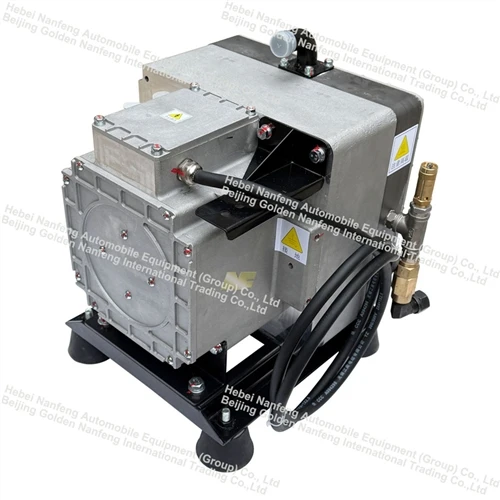
The primary components of a scroll air compressor are two involute scroll members with identical shapes but a 180° phase offset: one is a fixed scroll, and the other is an orbiting scroll driven by an eccentric shaft, with its axis orbiting the axis of the fixed scroll. During operation, the two scrolls make contact at multiple points to form sealing lines; combined with proper sealing at the scroll end faces, this creates several crescent-shaped air pockets. The sealing lines at the points of contact shift continuously along the scroll curves as the orbiting scroll moves, causing the shape and size of these crescent-shaped pockets to constantly change. The compressor's intake port is located in the upper part of the fixed scroll housing. As the eccentric shaft rotates clockwise, gas enters the intake chamber and is successively drawn into the peripheral crescent-shaped pockets connected to the intake chamber. Once these peripheral pockets close off from the intake chamber, their sealed volumes gradually shift toward the center of the fixed scroll while continuously shrinking, compressing the gas and raising its pressure.
Advantages of Scroll Air Compressors
1. Low Noise
(1) A 20HP (15kW) scroll air compressor produces only 62 dBA of noise, allowing for installation and use in virtually any location; this saves significantly on installation costs and better meets environmental standards.
(2) The absence of discharge valves and complex mechanical linkages eliminates valve-slapping sounds and airflow pulsation noise, drastically reducing overall noise levels.
(3) Intake and discharge processes are continuous and stable-occurring over 6,000 times per minute-resulting in minimal airflow pulsation.
2. Low Maintenance Costs
The compressor unit consists of few parts, with even fewer wearing parts, significantly reducing the likelihood of needing replacements. Additionally, the long service intervals for parts, ease of use, and minimal maintenance requirements result in low maintenance costs.
3. High Reliability
(1) The 4D scroll design allows the high-pressure section of the stationary scroll to withstand twice the pressure of a 2D scroll design.
(2) A microcomputer control system ensures enhanced stability and provides dual safety protection.
(3) The small turning radius results in a linear speed of only 2 m/s, leading to minimal wear, high mechanical efficiency, and low vibration.
(4) A reduction in the number of parts is a key factor in improving reliability.
4. Low Energy Consumption
(1) Due to the suction boosting effect and the absence of clearance volume, the volumetric efficiency of scroll air compressors exceeds 98%.
(2) As compression occurs gradually across multiple working chambers, the pressure difference between adjacent chambers is minimal, naturally resulting in very low leakage. The compression process is staged, leading to high thermal efficiency.
(3) The absence of suction and discharge valves means resistance losses during intake and exhaust are virtually zero. With no friction or wear from valve mechanisms, mechanical efficiency is high; this is a primary reason why scroll compressors are significantly more energy-efficient than other types of air compressors.
(4) Scroll compressors do not require an unloaded running state, resulting in 25.4% electricity savings compared to screw compressors.
Disadvantages of Scroll Air Compressors
1. High sealing requirements and complex sealing structures.
2. The surfaces of moving parts are predominantly curved; machining and inspecting these surfaces are complex-sometimes requiring specialized equipment-leading to higher manufacturing costs.
3. Sealing between moving parts (or between moving and stationary parts) is typically achieved by maintaining a specific operating clearance. Gas leakage through this clearance is inevitable, limiting the compressor's ability to achieve high compression ratios; consequently, most scroll compressors are used in air conditioning applications.