


Detailed Explanation of the Principle
of a Scroll Air Compressor
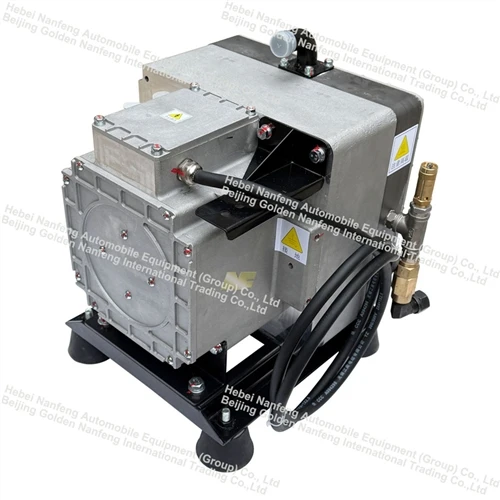
A scroll air compressor is a positive displacement compressor. Its core principle involves the interlocking of a fixed stationary scroll and an eccentrically rotating moving scroll, forming multiple crescent-shaped sealed compression chambers between them. As the moving scroll continuously rotates, the volume of these sealed chambers decreases, thus achieving continuous gas intake, compression, and discharge.
The core working process of a scroll air compressor's compression cycle mainly consists of three stages: Intake stage: Gas enters through the outer intake port of the scroll. As the moving scroll rotates, the outer intake port is sealed, forming a crescent-shaped sealed compression chamber.
Compression stage: The moving scroll continuously revolves around the center of the stationary scroll (without rotating on its own axis). This causes the volume of the sealed chamber to gradually decrease from the outside in, continuously compressing the gas towards the center, resulting in a continuous increase in pressure.
Discharge stage: When the gas is compressed to the exhaust port in the central region, the pressure reaches the set value, and the high-pressure gas is continuously discharged through the exhaust port.

Core Advantages and Features
Truly Oil-Free: Achieves high-quality clean gas without post-treatment.
High Efficiency: The unique vortex structure results in high volumetric efficiency, eliminating energy waste and maximizing efficiency.
Low Vibration: During rotation, the high-pressure zone is evenly distributed around the shaft, ensuring excellent balance and minimal vibration.
High Reliability: Fewer parts and a heat dissipation design enhance the compressor's reliability.
Low Noise: With very few main unit parts, there is virtually no collision noise, resulting in extremely low noise levels.
Maintenance-Free: Almost no vulnerable parts, leading to extremely low maintenance costs.


