


Detailed Introduction to
Permanent Magnet Synchronous Motors
Definition: A permanent magnet synchronous motor is a type of motor in which the rotor uses permanent magnets to generate a constant magnetic field, and the stator windings are energized with alternating current to generate a rotating magnetic field. The rotor speed is strictly synchronized with the speed of the stator's rotating magnetic field.
Main Structural Components
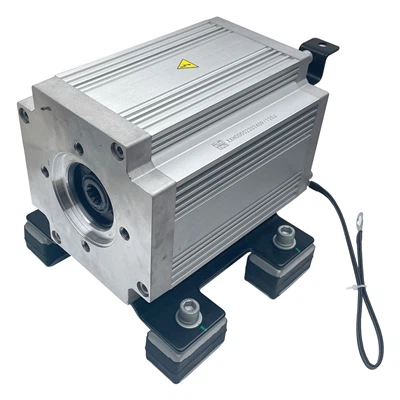
The physical structure of a permanent magnet synchronous motor mainly consists of a stator (stationary part) and a rotor (rotating part), as well as auxiliary components:
Stator: Stator core (stacked silicon steel sheets), three-phase (or multi-phase) windings, insulation system, and housing.
Function: Generates a rotating magnetic field when alternating current is applied; the housing also provides support and heat dissipation.
Rotor: Rotor core, permanent magnets (usually NdFeB or SmCo), shaft, sheath (for high-speed motors)
Function: The permanent magnets generate a constant excitation magnetic field; the rotor core forms the magnetic circuit, and the shaft outputs mechanical torque.
End Covers and Bearings: Front and rear end covers, bearings, cooling structure (air-cooled/liquid-cooled)
Function: Supports rotor rotation, ensures uniform air gap between stator and rotor, and removes heat from the motor.
Sensors (optional): Rotary transformer, Hall effect sensor, encoder
Function: Detects rotor position for high-precision speed regulation in vector control (FOC).
Main Principle:
① Magnetic Field Generation: Three-phase sinusoidal alternating current is applied to the stator windings, forming a synchronously rotating magnetic field in space (speed ns = 60f/p, f is the frequency, p is the number of pole pairs). The permanent magnets on the rotor establish a constant excitation magnetic field.
② Synchronous Operation: The stator rotating magnetic field and the rotor permanent magnet magnetic field couple, generating electromagnetic torque that "drags" the rotor to the same speed as the rotating magnetic field. When the load changes, the power angle between the rotor poles and the stator magnetic field adaptively changes to balance the torque, but the speed remains strictly synchronized, with no slip.
③ Control Method: To achieve efficient operation, field-oriented control (FOC) or direct torque control (DTC) is typically used. By detecting the rotor position, the stator current is decoupled into the excitation component that generates the magnetic field and the torque component that generates the torque, which are controlled separately, achieving speed regulation performance similar to a DC motor.


