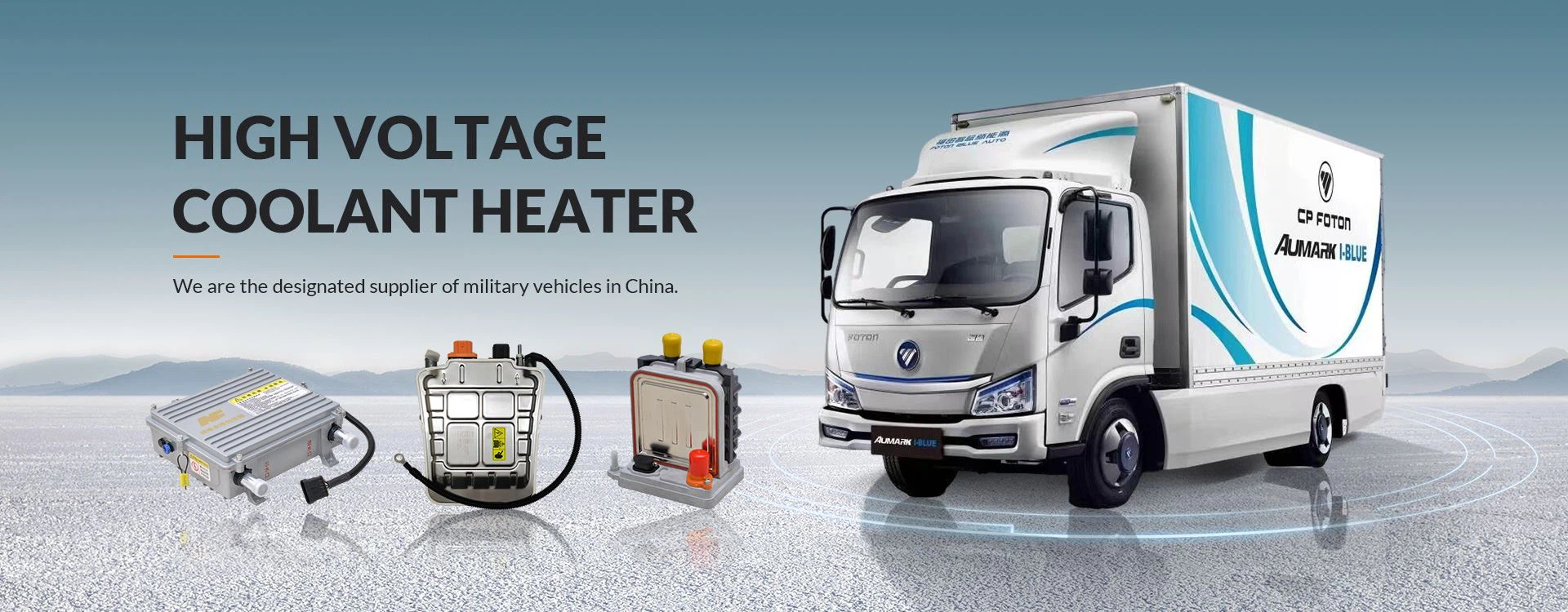


Why do most electric cars use PTC heating?
PTC is the abbreviation of Positive Temperature Coefficient, which means positive temperature coefficient, and generally refers to semiconductor materials or components with large positive temperature coefficient. Usually the PTC we mention refers to the positive temperature coefficient thermistor, or PTC thermistor for short. The PTC thermistor is a typical temperature-sensitive semiconductor resistor. When it exceeds a certain temperature (Curie temperature), its resistance The value increases stepwise as the temperature increases.
Features of PTC heater:
Heaters made of PTC ceramic heating elements have excellent temperature regulation and energy-saving characteristics, extremely low thermal inertia, safety without open flames and radiation, and good vibration resistance. The reason why PTC heaters are energy-saving is that their output power will significantly decrease as the ambient temperature increases. When the air volume remains unchanged, when heating causes the ambient temperature to rise, the PTC power has decreased. This feature is due to a certain extent. When it comes to the function of automatic power adjustment, on the other hand, it can also be understood that as the room temperature increases, the greater the PTC output power and the faster the heating.
As the room temperature increases, the PTC output power gradually decreases, and the heating effect becomes slower. High power density is also one of the significant features of PTC heaters. PTC heaters use forced convection to heat room temperature. Because the heat transfer coefficient of forced convection air is dozens of times that of natural convection, the heat exchange area required to transfer the same heat can be as small as a few tenths. This is exactly the same Under high power conditions, the key to making the PTC heater small and light is that its size and weight can be as small as about one-fifth of an electric heating oil heater with the same power.


Aging attenuation is one of the most important parameters to measure the quality of PTC heaters. PTC components age fastest in the first 400 hours of use, and then become more gradual. After 1,000 hours of continuous operation, the output power of a good PTC component will attenuate by about 10%. left and right, and then levels off, which has little impact on the heating function of the PTC heater.
The constant-temperature heating PTC thermistor has constant-temperature heating characteristics. The principle is that after the PTC thermistor is powered on, it self-heats and the resistance value enters the transition zone. The surface temperature of the constant-temperature heating PTC thermistor will maintain a constant value. This temperature is only related to the PTC The Curie temperature of the thermistor is related to the applied voltage and has basically nothing to do with the ambient temperature. Constant temperature heating PTC thermistors can be made into a variety of shapes and structures and different specifications. Common ones include disc shape, rectangle, strip shape, ring shape, honeycomb porous shape, etc. The above-mentioned PTC heating elements and metal components can be combined to form Various forms of high-power PTC heaters.
PTC heaters are classified according to conduction mode:
PTC ceramic heaters mainly based on heat conduction are characterized by an electrode plate (electrical conduction and heat transfer) installed on the surface of the PTC heating element (electrical conduction and heat transfer), an insulating layer (electrical isolation and heat transfer), and a heat-conducting heat storage plate (some also have thermal conductive glue attached). Multi-layer heat transfer structures such as PTC elements transfer the heat emitted by the PTC element to the heated object. Various PTC ceramic air heaters use the formed hot air to conduct convection heat transfer. They are characterized by high output power and automatic adjustment. The characteristics of the infrared radiation heater are that it actually uses the heat quickly emitted from the surface of the PTC element or thermal conductive plate to directly or indirectly stimulate the far-infrared paint or far-infrared material in contact with the surface to radiate infrared rays. PTC ceramic infrared radiation heater.
The working efficiency and utilization rate of the air conditioning system of electric vehicles have a great impact on the cruising range. In particular, the use of warm air will consume more electrical energy. For cars with gasoline engines, the warm air directly uses the heat dissipation of the engine. Generally, cold air consumes more energy than warm air. The heating of electric vehicles is actually a process of converting the electric energy of the power battery into heat energy through a heating device. Most electric vehicles currently use PTC (Positive Temperature Coefficient) heating devices, and PTC heating devices can be subdivided into There are two forms: directly heating the air or heating and cooling circulating water and then generating heat.