

Why We Added a Fan to Our 24V Water Pump
Engineering note from NF Group. The 600W electronic coolant pump now ships with an axial fan on the motor end. It is a small change with a clear purpose: protect the pump itself when the vehicle is slow, the coolant is hot and the thermal loop cannot stop. Here is the reasoning behind it.
The Problem: Heat the Coolant Cannot Carry Away
An electronic coolant pump lives inside a loop that is already moving heat. In an electric bus the coolant may be carrying heat from the battery, the drive motor, the inverter or a PTC heater. By the time it reaches the pump, it is warm. A conventional canned pump relies on its aluminium shell and surrounding airflow to shed the heat generated by its own motor and drive board. When the vehicle is stationary or crawling through traffic, that airflow is almost absent.
Industry experience puts a number on it: below roughly 40 km/h, natural airflow through the grille is not enough for reliable heat rejection. Active fans create the static pressure needed to pull air through dense fin packs. The same physics applies to a pump motor, just on a smaller scale.
What Changed on the 600W Pump
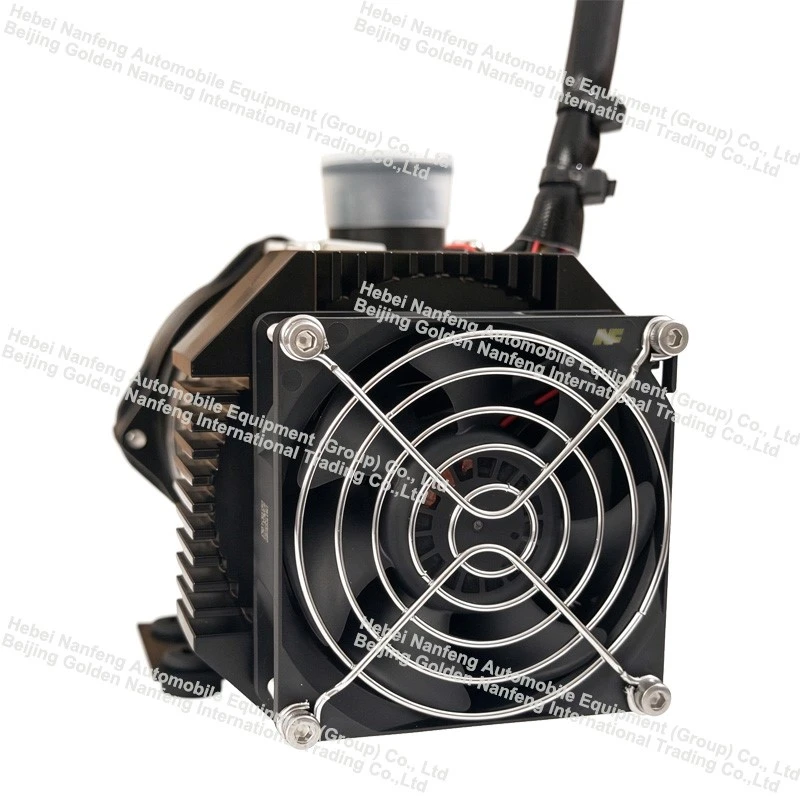
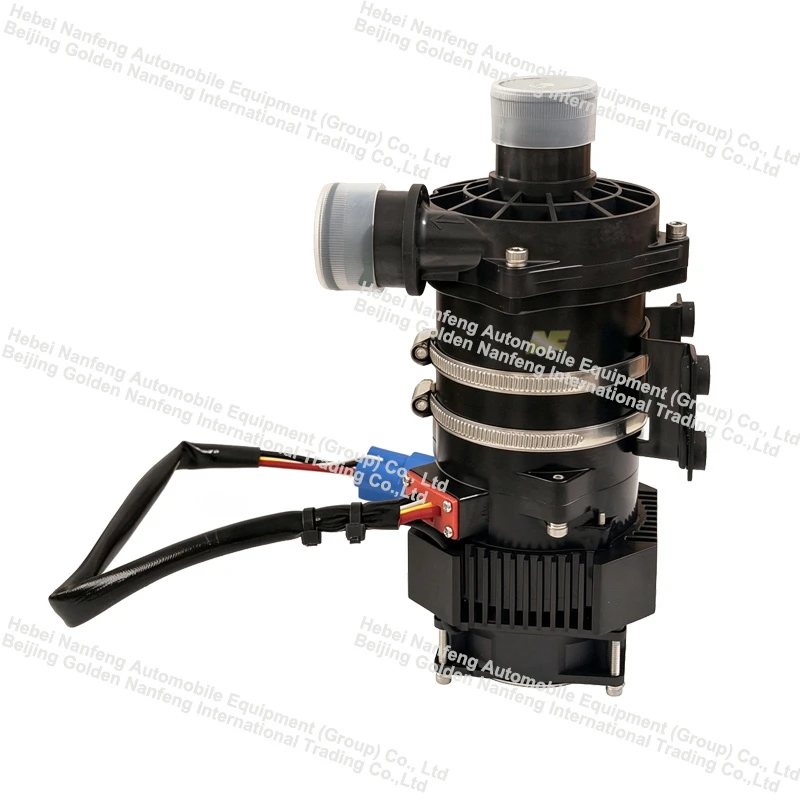
We mounted an axial fan behind a metal guard at the non-drive end of the motor, where it blows across the cast cooling fins. It is mechanically driven by the pump, so it runs whenever the pump runs. There is no extra harness, no separate controller and no firmware to calibrate. The guard protects the blades and prevents accidental contact during service.
Four Engineering Reasons
1. A separate heat path for the motor and driver
The coolant removes heat from the vehicle components. The fan removes heat from the pump. Keeping those two jobs separate means the pump does not inherit every temperature problem in the loop.
2. Stable output at low vehicle speed
Motor temperature affects winding resistance, efficiency and available output. When a motor overheats, controllers typically reduce power to protect insulation and bearings. Forced airflow reduces the chance that the pump itself triggers a derate in a hot bus or a charging vehicle.
3. Longer life for bearings, insulation and electronics
Most electronic water pump failures trace back to the sliding bearing pair. Heat accelerates lubricant breakdown, ages rubber parts, can deform plastic impellers and degrades the insulation of the encapsulated drive board. Lower operating temperature is the simplest way to slow all of those mechanisms. The fan complements IP67 sealing, the brushless motor, soft start and no-load protection.
4. More power in the same space
The 600W pump measures 245 × 115 × 147 mm. Forced air lets us hold that envelope at continuous duty instead of enlarging the housing to gain cooling surface. That matters when the available space next to a battery pack is measured in millimetres.
|
Finned housing and D38 ports |
Where the pump works: buses, trucks, logistics |

What It Means for Fleet Operators
The benefit is not a higher headline flow number. It is a pump that keeps the headline flow when the vehicle is idling in July, climbing a grade with a hot battery, or parked at a fast charger with the cooling loop still running. Fewer temperature-driven power limits mean more predictable cabin heating, battery conditioning and component cooling - and fewer surprise visits to the workshop.
Availability and Key Data
| Item | Value |
|---|---|
| Model | BLT484654-24V-600W-D38 |
| Voltage / power | 24 V DC (18–35 V) / 600 W |
| Flow / pressure | 7600 ± 10% L/h / 3.7 ± 0.1 bar |
| Protection / life | IP67 / 10,000 hours |
| Speed control | PWM; CAN on request |
| Typical lead time | Confirm with sales for your quantity and harness specification |
|
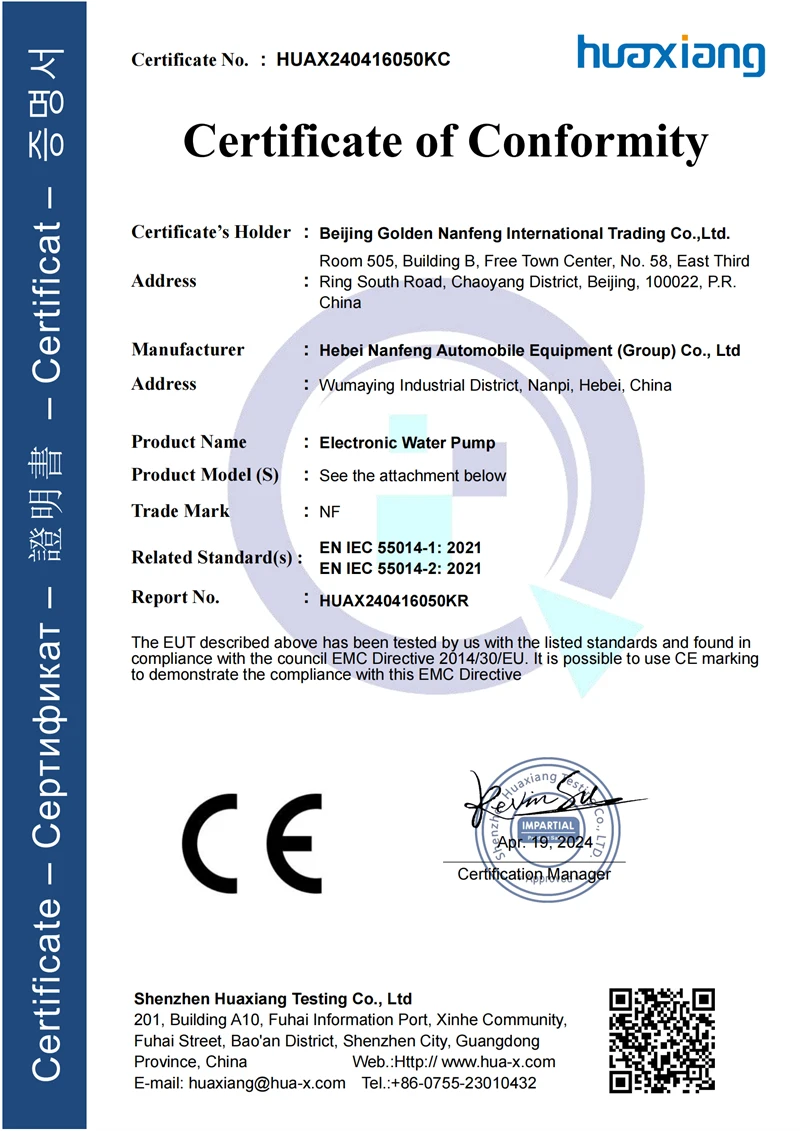
CE conformity |
NF Group at an industry exhibition |

Questions From Buyers
Is the fan a radiator fan?
No. It is small, mounted on the pump motor and dedicated to cooling the pump. The vehicle still needs its own radiator and radiator fan.
Does it add noise?
The complete pump is specified at no more than 70 dB(A). The brushless motor is quiet; the fan adds airflow noise but remains within the published limit.
Can I specify a pump without the fan?
Yes. Tell us the application and we will confirm whether the standard or fan-cooled version is the better fit.
Where can I see the full specification?
The 600W fan-cooled pump page carries the complete parameter table, wiring and installation notes.
Want the engineering drawing or a sample for evaluation? Contact NF Group with your coolant temperature, voltage platform and installation space.